
Ask any Port St. Lucie driver what happens to a fresh coat of wax, and you will get the same answer: it looks incredible for a couple of weeks, then the Florida sun, afternoon storms and salt air start winning. By the next month, water stops beading and the paint feels rough to the touch again.
This guide compares wax and ceramic coating honestly - what each one is, how long each one lasts in our climate, what they cost, and how to decide which is right for your car, truck, boat or motorcycle.
Why Florida is hard on paint
The Treasure Coast is one of the toughest environments in the country for a vehicle's finish. A few local reasons stand out:
- UV intensity. Year-round strong sun breaks down the organic oils in traditional wax, which is why a wax job fades so quickly here compared to up north.
- Salt air. Living near the coast means a fine layer of salt lands on your paint constantly. Left unprotected, it contributes to oxidation and surface staining.
- Afternoon storms. Hard rain and standing water leave mineral spots that etch into unprotected clear coat under the sun.
- Sand and road grime. Everyday driving kicks up grit that bonds to the surface and dulls the gloss.
What wax actually does
Wax is a natural or synthetic blend that sits on top of your paint. It adds a warm glow and a short-lived layer of slickness. The catch is that it never bonds to the clear coat - it wears off with each wash, rainstorm and hot afternoon.
- Realistic lifespan in Florida: roughly 4-8 weeks for most products.
- Best for: a quick refresh before an event, or vehicles that are already coated and just want a top-up.
- Trade-off: constant reapplication, and no real protection against UV or water spotting once it fades.
What a ceramic coating does
A true ceramic coating is a liquid SiO2 (silicon dioxide) product that cures into a hard, glass-like layer bonded to your clear coat. It does not sit on top - it becomes part of the surface.
- Realistic lifespan: 5 years when professionally installed, which is what our SunCoat Plus packages are built around.
- Hydrophobic: water and dirt are repelled on contact, so the car stays cleaner between washes and is far easier to maintain.
- UV and stain resistance: it helps block the UV damage and water spotting that destroy unprotected paint in Florida.
- Value: a coated, well-kept finish holds its gloss and resale appeal for years.
The trade-off is upfront cost and prep. A coating is only as good as the surface underneath it, so professional installation always starts with a wash, a clay bar decontamination and a machine polish to remove swirls and scratches.

The honest comparison
| Wax | Ceramic coating | |
|---|---|---|
| How it bonds | Sits on top of paint | Bonds to the clear coat |
| Lifespan in Florida | 4-8 weeks | Up to 5 years |
| UV protection | Weak, fades fast | Strong |
| Water beading | Fades quickly | Lasts for years |
| Maintenance | Reapply often | Wash and top-up |
| Upfront cost | Low | Higher, includes paint correction |
If you want the best possible protection and the least ongoing work, a ceramic coating wins clearly. If you simply want a quick shine and you enjoy detailing your own car on weekends, wax still has a place.
Does your car need paint correction first
Almost always, yes - and this is the step most people underestimate. Swirls, light scratches and oxidation are locked in permanently if you coat over them. Paint correction is what removes those defects and unlocks the depth and gloss the coating is supposed to protect.
- New vehicles (2025 and newer): usually need only a light enhancement.
- Daily drivers: a single-stage polish removes the large majority of swirls.
- Heavily swirled or neglected paint: a multi-stage cut and polish is the way to get it looking its best.
Boats, RVs and motorcycles count too
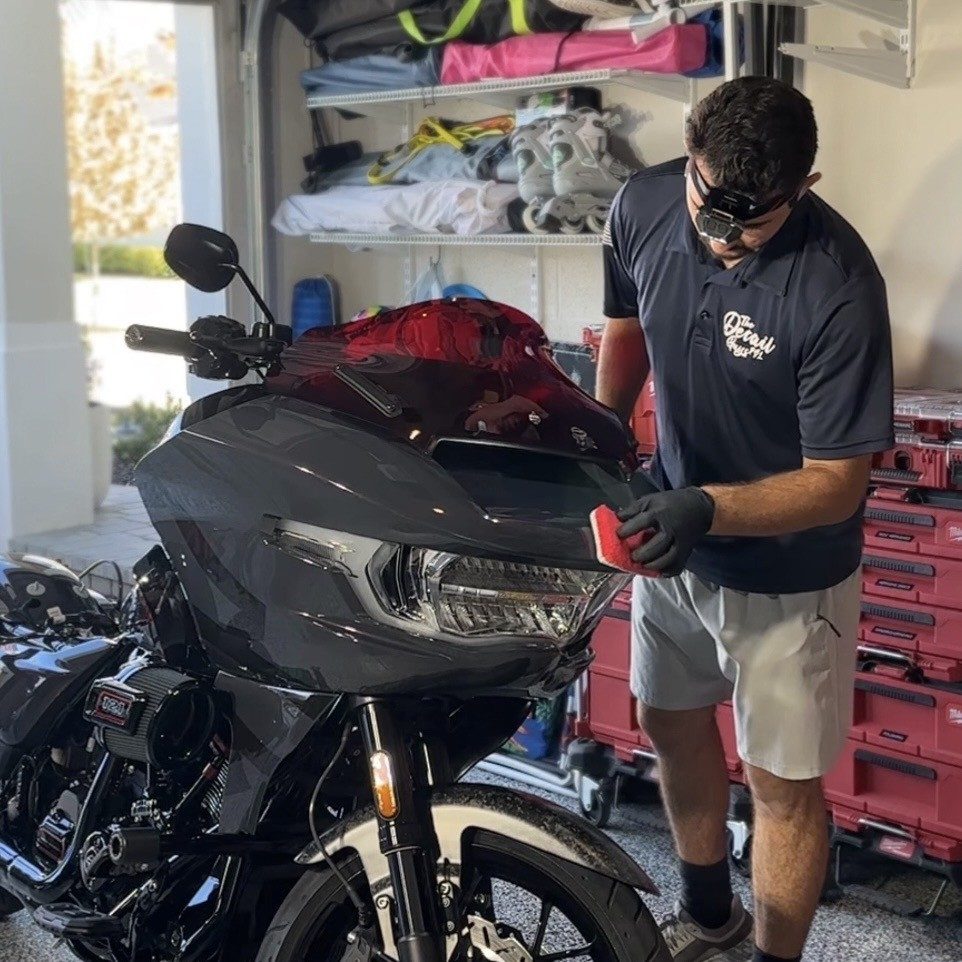
Everything above applies to more than cars. Boat gelcoat and RV fiberglass oxidize fast in the sun and benefit enormously from a coating, and a coated motorcycle is far easier to keep show-ready. We offer coating packages for all of them, alongside our standard detailing services.
Frequently Asked Questions
1. How long does a ceramic coating really last in Florida?
Professionally installed coatings in our 5-year packages are designed to last up to five years with proper washing. Cheaper spray-on products sold as ceramic coatings typically last a few months at best.
2. Is ceramic coating worth it on a daily driver?
Yes. A daily driver sees the most sun, rain and road grime, so it benefits the most. A single-stage polish with a 5-year coating is the package most of our Port St. Lucie clients choose.
3. Can I put wax over a ceramic coating?
You can, but you do not need to. A wax top-up can add temporary gloss, but the coating is doing the real work. Regular washing and an occasional maintenance wash are what keep it performing.
4. Do you need my car in a garage to install a coating?
Yes. Ceramic coatings need a clean, dust-free space to cure properly, so we install in a garage or by shop drop-off. A deposit is required to book.
5. How much does ceramic coating cost in Port St. Lucie?
Pricing depends on your vehicle size and how much paint correction it needs, so we quote each car individually. Call or text us and we will give you a clear, upfront price.
Get your paint protected
The Detail Guys PSL installs paint correction and ceramic coatings across Port St. Lucie, Stuart, Jensen Beach, Palm City and the Treasure Coast. If you are tired of wax fading every few weeks, give us a call at (561) 275-8481 and we will recommend the right package for your vehicle. You can see everything we offer on our mobile detailing services page, including ceramic coating packages.